

Better Understanding God’s Guidance
Download StudyWhat a mind-boggling wonder that God would empty Himself, taking the form of a bond-servant, and being made in the likeness of men. Being found in appearance as a man, and that He made Him who knew no sin to be sin on our behalf, so that we might become the righteousness of God in Him (Philippians 2:7–8; 2 Corinthians 5:21). This unfathomable truth—that God would incarnate Himself to save us from our sin— bespeaks the depth of love expressed.
This same infinite and personal God cares not only for our eternal destiny, but also for the here and now. He is not removed from our day-to-day existence but is here to care and to guide. With that introduction in mind, this study should be a great aid to you as you reflect on upcoming goals and how you will best invest all that God has given you for maximum impact on the maximum number of people for His glory! May God bless you as you study this lesson.
I. INTRODUCTION
You have probably heard the now-cliché-like saying, “God has a wonderful plan for your life!” If you have not rejected Him as your Savior and Lord, I believe that statement to be true. God is sovereign, and He has a purpose for all of His creation. He has a plan or “will” for each of us, gifting us and providing us with time, talent, and treasure of varying degrees in order to achieve His specific purposes for our lives.
We often make His will more difficult to respond to than it really is. For the obedient believer, it would require a great deal of prolonged gymnastics to get out of the center of His will. In this lesson, we will explore God’s will and how we are guided into His will.
II. GOD’S WILL
A. THE MEANING OF GOD’S SOVEREIGN WILL
God’s sovereign will involves His ultimate, complete control over everything. Nothing happens that was not in God’s plan. History is really the unfolding of God’s purposes, which happen exactly as He has planned.
Read the following verses and write out the key thought about God’s sovereign will:
The Lord of hosts has sworn saying, “Surely, just as I have intended so it has happened, and just as I have planned so it will stand” (Isaiah 14:24).
Also we have obtained an inheritance, having been predestined according to His purpose who works all things after the counsel of His will (Ephesians 1:11).
“Remember the former things long past For I am God, and there is no other; I am God, and there is no one like Me,
Declaring the end from the beginning, And from ancient times things which have not been done, Saying, ‘My purpose will be established, And I will accomplish all My good pleasure’” (Isaiah 46:9–10).
B. THE MEANING OF GOD’S COMMANDED WILL
God’s commanded will is revealed throughout the Bible as laws or principles. It is that aspect of His will to which men are held accountable.
According to the Great Commission, what are new believers to be taught? “Teaching them to observe all that I commanded you; and lo, I am with you always, even to the end of the age” (Matthew 28:20).
God gave two great commandments. Paraphrase these two commandments on the lines below each verse. And He said to him, “‘You shall love the Lord your God with all your heart, and with all your soul, and with all your mind’” (Matthew 22:37).
“The second is like it, ‘You shall love your neighbor as yourself’” (Matthew 22:39).
C. THE NATURE OF GOD’S WILL
God’s sovereign will and commanded will are better understood in light of their respective characteristics. Study the following table and be ready to test your understanding of God’s sovereign will and His commanded will. A teaser—do you ever attribute something to “the sovereignty of God” that, in essence, is the responsibility of man?
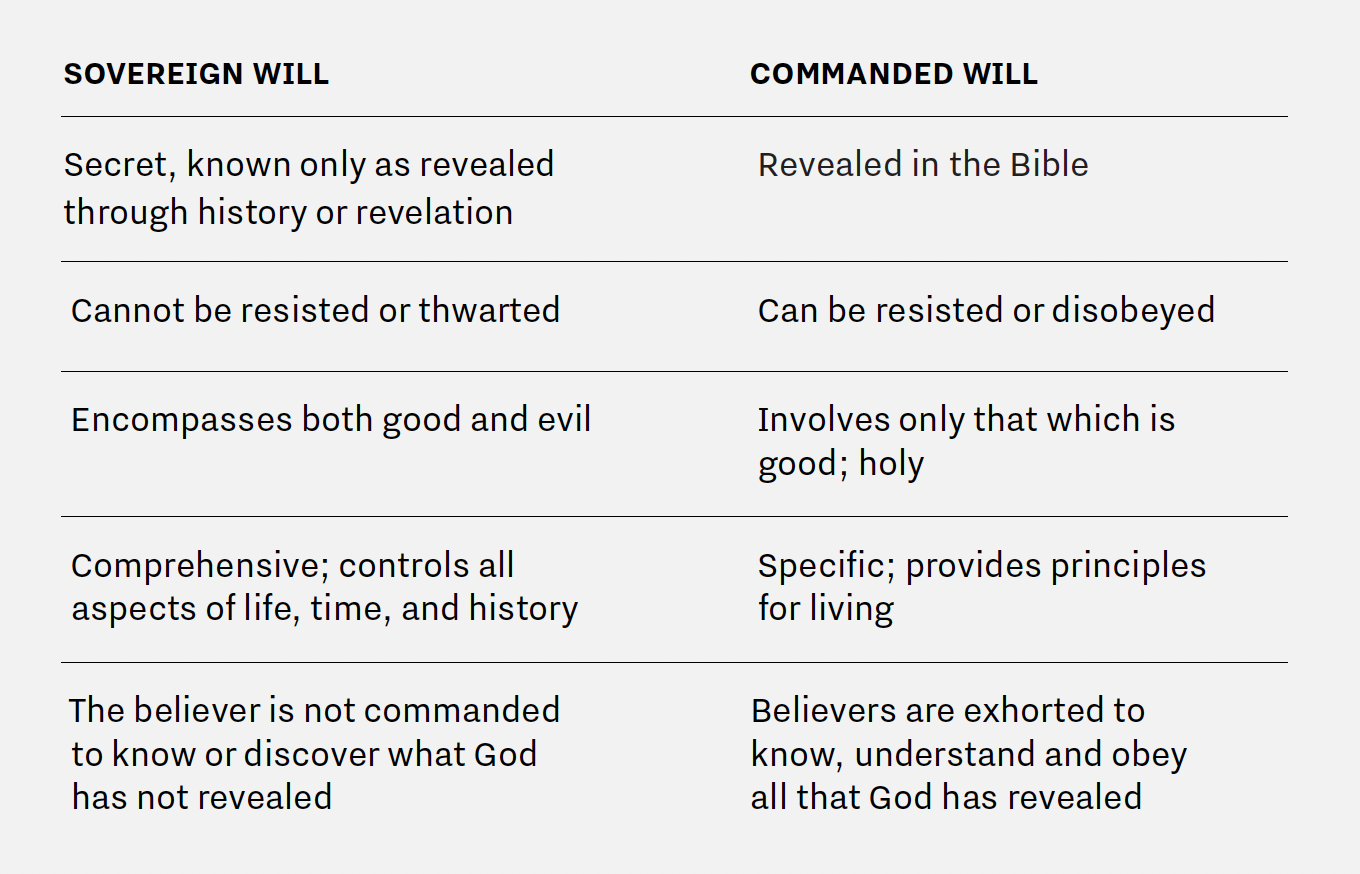
Write out the part of the verse that conveys God’s will. Circle the appropriate letter. (Key: S = Sovereign, C = Commanded)
For it is God who is at work in you, both to will and to work for His good pleasure (Philippians 2:13).
S C
For this is the will of God, your sanctification; that is, that you abstain from sexual immorality (1 Thessalonians 4:3).
S C
Do not be bound together with unbelievers; for what partnership have righteousness and lawlessness, or what fellowship has light with darkness? (2 Corinthians 6:14)
S C
“Not everyone who says to Me, ‘Lord, Lord,’ will enter the kingdom of heaven, but he who does the will of My Father who is in heaven will enter” (Matthew 7:21).
S C
For I am confident of this very thing, that He who began a good work in you will perfect it until the day of Christ Jesus (Philippians 1:6).
S C
‘“For I know the plans that I have for you,’ declares the Lord, ‘plans for welfare and not for calamity to give you a future and a hope’” ( Jeremiah 29:11).
S C
Christianity best defined is not a religion; rather, it is a personal relationship with Christ. Incumbent in a personal relationship is exactly that—a personal relationship. If that understanding is correct, then it follows that a believer should presuppose that God has a special plan for his life and that He will guide him all the way. How do we best understand and discern that personalized guidance from above?
D. THE RESPONSE TO GOD’S WILL
How should we respond to God’s sovereign will?
Trust in the Lord with all your heart And do not lean on your own understanding.
In all your ways acknowledge Him, And He will make your paths straight (Proverbs 3:5–6).
Therefore, those also who suffer according to the will of God shall entrust their souls to a faithful Creator in doing what is right (1 Peter 4:19).
Come now, you who say, “Today or tomorrow we will go to such and such a city, and spend a year there and engage in business and make a profit.” Yet you do not know what your life will be like tomorrow. You are just a vapor that appears for a little while and then vanishes away. Instead, you ought to say, “If the Lord wills, we will live and also do this or that” ( James 4:13–15).
How should we respond to God’s commanded will?
So then do not be foolish, but understand what the will of the Lord is (Ephesians 5:17).
“The secret things belong to the Lord our God, but the things revealed belong to us and to our sons forever, that we may observe all the words of this law” (Deuteronomy 29:29).
How does the previous passage in particular summarize the differentiation of God’s sovereign will and God’s commanded will?
“You shall therefore love the Lord your God, and always keep His charge, His statutes, His ordinances, and His commandments” (Deuteronomy 11:1).
God instructs, we obey.
Good and upright is the Lord; Therefore He instructs sinners in the way.
He leads the humble in justice, And He teaches the humble His way.
All the paths of the Lord are lovingkindness and truth To those who keep His covenant and His testimonies (Psalm 25:8–10).
III. GOD’S GUIDANCE
Because of His great love, God has predestined, called, justified, and will glorify all believers. He also guides day-by-day; He is intimate with the upright!
A. THE MEANING OF GUIDANCE
Guidance is God’s active role in our lives, accomplishing His purposes. Note the following words used in the Bible to describe guidance. Write down how the verse conveys the meaning of each word:
1. Lead (“to shepherd; to bear or carry”)
But He led forth His own people like sheep And guided them in the wilderness like a flock (Psalm 78:52).
And see if there be any hurtful way in me, And lead me in the everlasting way (Psalm 139:24).
2. Guide (“to show, to help understand”)
He restores my soul; He guides me in the paths of righteousness For His name’s sake (Psalm 23:3).
With Your counsel You will guide me, And afterward receive me to glory (Psalm 73:24).
3. Direct (“to establish or prepare; to make straight”)
The mind of man plans his way, But the Lord directs his steps (Proverbs 16:9).
May the Lord direct your hearts into the love of God and into the steadfastness of Christ (2 Thessalonians 3:5).
A. THE NATURE OF GUIDANCE
The following chart outlines ways in which God guides people directly or indirectly.
| DIRECT GUIDANCE | INDIRECT GUIDANCE |
| Spoken revelation of God | God’s Word |
| Visions | Conscience or conviction |
| Dreams | Providence (circumstances controlled by God) |
| Prophet/apostle | Wisdom and counsel |
Direct guidance was experienced during the Old Testament and early New Testament time periods. Today God primarily guides indirectly. The Holy Spirit is active in all areas of indirect guidance as part of His ministry in the believer.
B. GUIDANCE THROUGH GOD’S WORD
How does the psalmist describe God’s Word?
Your word is a lamp to my feet And a light to my path (Psalm 119:105).
C. GUIDANCE THROUGH CONVICTION
How was Paul stimulated to action in Athens? Now while Paul was waiting for them at Athens, his spirit was being provoked within him as he was observing the city full of idols (Acts 17:16).
D. GUIDANCE THROUGH GOD’S PROVIDENCE
About what can the believer be confident regardless of the circumstances? And we know that God causes all things to work together for good to those who love God, to those who are called according to His purpose (Romans 8:28).
E. GUIDANCE THROUGH GOD-GIVEN WISDOM
Read Proverbs 2:1–11. What four things will wisdom allow you to discern (v. 9)?
1My son, if you will receive my words And treasure my commandments within you,
2Make your ear attentive to wisdom, Incline your heart to understanding;
3For if you cry for discernment, Lift your voice for understanding;
4If you seek her as silver And search for her as for hidden treasures;
5Then you will discern the fear of the Lord And discover the knowledge of God.
6For the Lord gives wisdom; From His mouth come knowledge and understanding.
7He stores up sound wisdom for the upright; He is a shield to those who walk in integrity,
8Guarding the paths of justice, And He preserves the way of His godly ones.
9Then you will discern righteousness And justice and equity and every good course.
10For wisdom will enter your heart And knowledge will be pleasant to your soul;
11Discretion will guard you, understanding will watch over you.
IV. APPLICATION
List one area in which you are wrestling with a decision and need guidance in the coming year.
Relative to the four areas/kinds of direction God has made available to you per this study, evaluate your thinking and decision based on each form of His indirect guidance, and list several steps you plan to take to follow God’s direction.
What are some applicable principles from God’s commanded will that come into play in terms of direction and guidance from scriptural passages?
Are the convictions of your conscience based on biblical principles? If so, what does your conscience inform you is the right thing to do?
What are the extenuating circumstances surrounding the situation? Importantly, do the extenuating circumstances stem from another’s obedience or disobedience to the Word of God? Accordingly, does the decision you need to make stem from the sovereign will of God or the irresponsibility of man? (Don’t facetiously categorize something as “the sovereign will of God in my life” and take no action because of your misdiagnosis, i.e., spiritualizing the matter.)
How does God’s wisdom specifically increase and inform your discernment in relationship to your decision? What do your godly counselors think and recommend?
How long have you prayed about this matter and sought God’s guidance?
After considering and answering these questions, what is your decision based on?